


Event Introduction
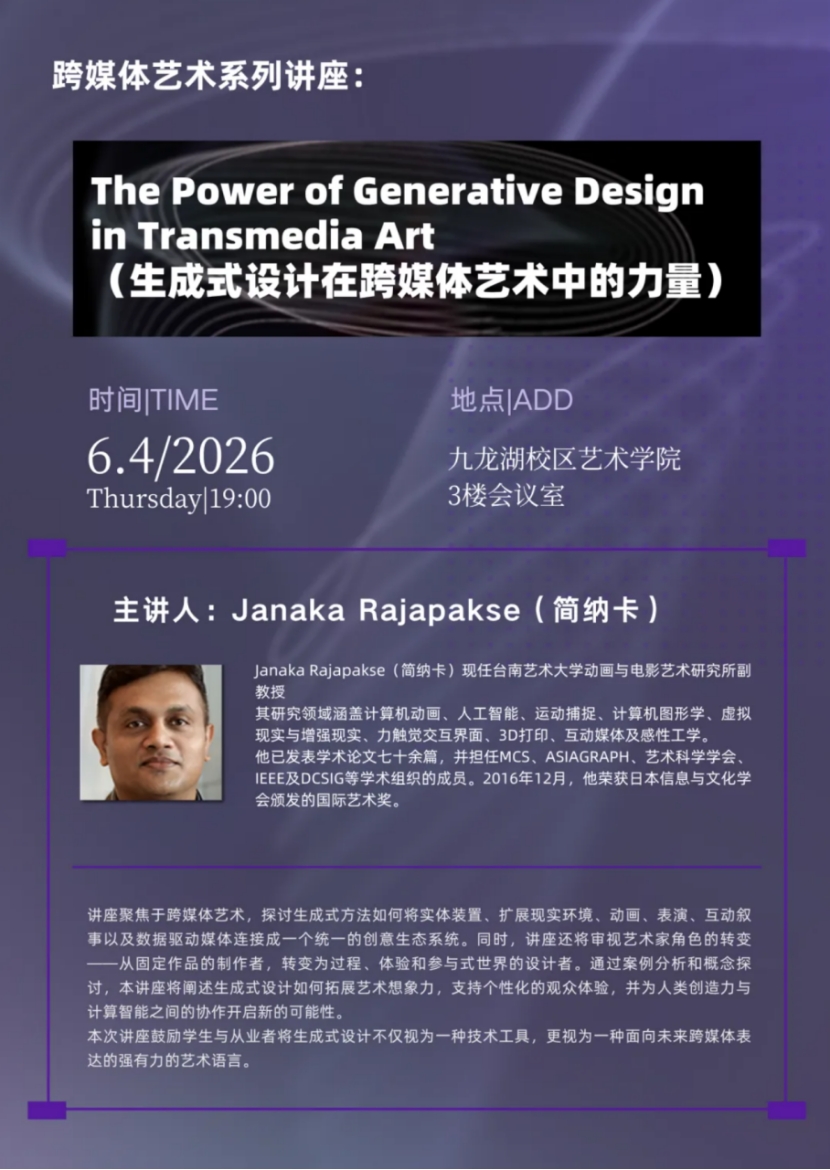
Generative design is transforming how artists, designers, and audiences imagine, create, and experience cross-media art. This lecture will explore the power of generative design as a creative methodology, combining algorithmic thinking, artificial intelligence, real-time data, and interactive systems to generate dynamic art experiences across multiple media platforms. Generative design does not view digital tools as simple production aids, but rather empowers creators to define rules, parameters, and systems, thereby generating unexpected forms, narratives, sounds, movements, and visual expressions. The lecture focuses on cross-media art, exploring how generative methods connect physical installations, extended reality environments, animation, performance, interactive narratives, and data-driven media into a unified creative ecosystem. Simultaneously, the lecture will examine the shift in the artist's role—from creator of fixed works to designer of processes, experiences, and participatory worlds. Through case studies and conceptual discussions, this lecture will illustrate how generative design expands artistic imagination, supports personalized audience experiences, and opens new possibilities for collaboration between human creativity and computational intelligence. This lecture encourages students and practitioners to view generative design not only as a technological tool, but also as a powerful artistic language for future cross-media expression.
Speaker Introduction
Speaker Name: Janaka Rajapakse Nationality: Sri Lanka Speaker Bio: Janaka Rajapakse is currently an Associate Professor at the Graduate Institute of Animation and Film Arts, Tainan National University of the Arts, and has been a Visiting Researcher at Tokyo Polytechnic University since April 2010. He held academic positions at the same Taiwanese university (2010–2013) and Tokyo Polytechnic University (2008–2010), and served as a research assistant at the Japan Advanced Institute of Science and Technology (JAIST) from 2005 to 2008. He received his undergraduate degree from the University of Colombo and later obtained his master's and doctoral degrees from JAIST with a Japanese government scholarship. His research areas include computer animation, artificial intelligence, motion capture, computer graphics, virtual reality and augmented reality, force-haptic interfaces, 3D printing, interactive media, and sensible engineering. He has published over seventy academic papers and serves as a member of academic organizations such as MCS, ASIAGRAPH, the Society for Arts and Sciences, IEEE, and DCSIG. In December 2016, he received the International Art Award from the Japan Society for Information and Culture.


